
Contest Chair Guide: You're Running
the Show.
The Contest Chair organizes the contest, hosts the evening, and makes sure everything runs smoothly from the first email to the last certificate. It's one of the biggest leadership roles you can take on at Gilbert. It's also one of the most rewarding.
Here's how to do it well.
From first email to contest night
The Timeline
- 8
weeks before
Order the awards.
Engraving takes time. Don't wait. Check with the Treasurer for the budget, and start looking for trophies or awards early. You'll need first place and second place for each contest, plus participation certificates for every contestant.
Start planning.
Talk to the Chief Judge. You two will be working together closely from here to contest night.
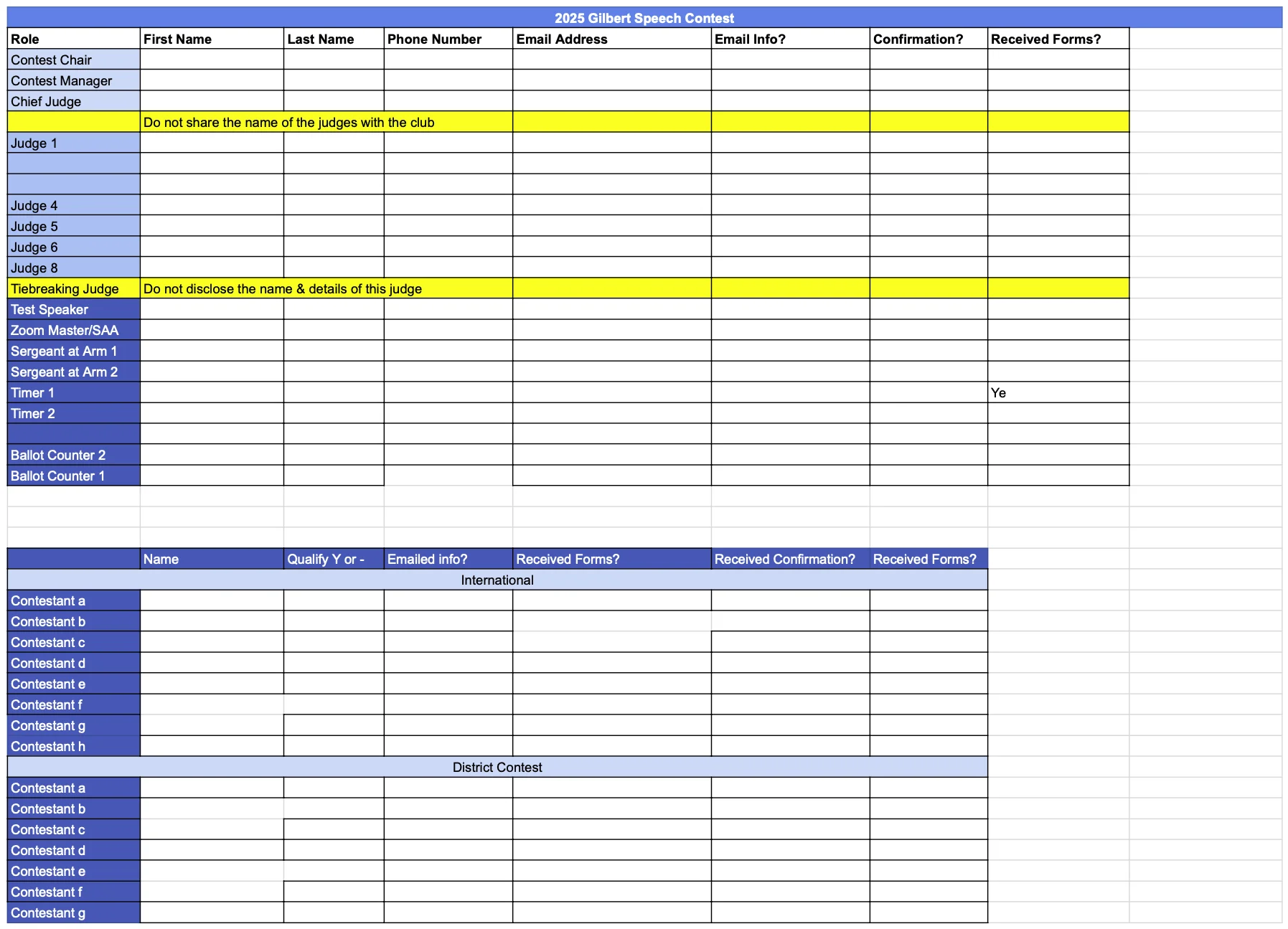
Here's the spreadsheet we use at Gilbert. Recreate it as a new Google Sheet and share it with the Chief Judge. It has two parts: a table of every functionary, with their contact details and whether they've confirmed and sent their forms, and a table of contestants for each contest, with their eligibility and paperwork status.
- 6
weeks before
Recruit contestants.
Aim for at least five per contest. Here's what actually works:
Send a mass email to the club with the contest date, a description of the contest, and a call for participants. This makes people aware. Don't expect sign-ups from the email alone.
Then show up to meetings and ask people in person. “Hey, you'd be great in this contest. Should I write you down?” is more effective than any email. A personal ask, face to face, is how you fill the roster.
For members you haven't caught at a meeting, a call or text is the next best thing.
Check eligibility.
The rules depend on the contest. For the International Speech Contest, contestants must have completed Levels 1 and 2 of any Pathways path. For other contests, there's no education requirement, just paid membership in good standing. Some district roles rule a contestant out too, so if anyone serves the district or is running for a district office, check the current Speech Contest Rulebook on toastmasters.org.
For Evaluation Contests: find a test speaker.
For Table Topics Contests: choose the question.
- 3
weeks before
Send contestant information packets.
Each contestant needs:
- The relevant section of the Speech Contest Rulebook
- The Speaker's Certification of Eligibility and Originality form
- The Speech Contestant Profile form
All forms are available on toastmasters.org in the Resource Library. Let contestants know they can fill out the forms at home or at the meeting before the contest. Tell them to arrive early on contest night.
- 1
week before
Check the functionaries with the Chief Judge.
The Chief Judge recruits the judges, timers, ballot counters, and Sergeants-at-Arms. Make sure they have every role filled, and help complete the roster if there are gaps. The tiebreaker judge is the one name you don't ask for: only the Chief Judge knows who it is.
Create the agenda.
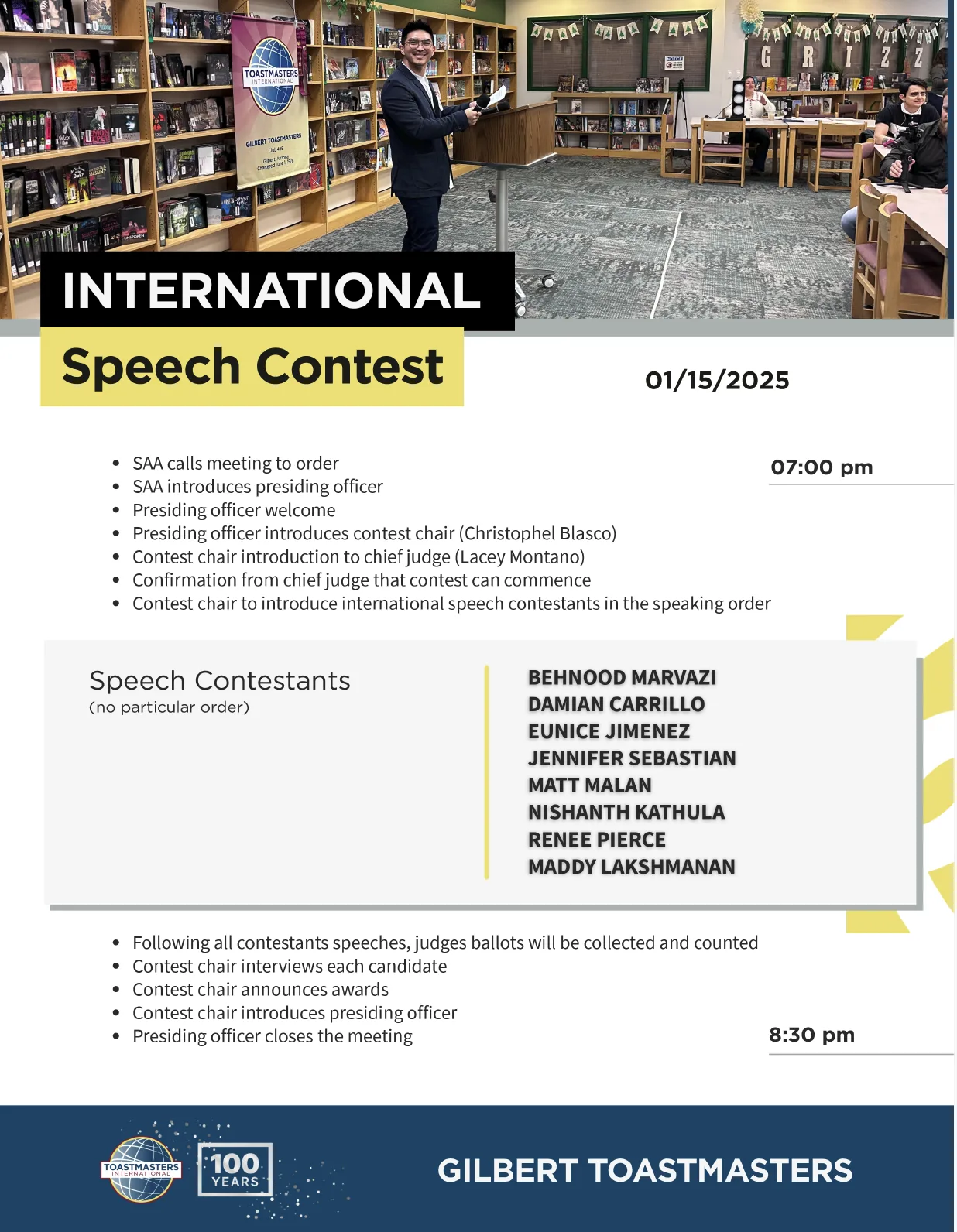
This is your agenda. You build it. The contest agenda is the only agenda at Gilbert that gets printed in color. Make it count.
Print certificates.
First place, second place, and participation certificates for every contestant. For each contest you're running.
Handle last details.
Confirm the contestant order will be selected randomly on contest night (bring playing cards or another method). Prepare any materials you'll need for the evening. Have a plan to entertain the audience during ballot counting.
- 1
day before
OptionalSend a note of encouragement.
Send a short email or text to the contestants. Not logistics, just encouragement. Remind them to have fun and enjoy their evening. It goes a long way.
Contest Night
Before the Meeting
Arrive early and brief the contestants together. Make sure you have all their forms, then walk them through:
- The speaking order: draw it in front of them with playing cards, dice, or names from a hat
- The timing signals: where the timer sits and what each signal means
- The microphone: how it works and whether they can move with it
- The stage area: where to stand and how much room they have
Then answer their questions.
If you're running an Evaluation Contest, confirm the test speaker is there and knows their time limit.
The Flow
- 1
7:00 PM
SAA calls the meeting to order.
SAA introduces the presiding officer (usually the President). The presiding officer introduces you as Contest Chair.
- 2
Then
You take over from here.
You're the host for the evening. Introduce the Chief Judge and confirm the contest is ready to proceed. Then introduce the contestants.
- 3
Between speeches
Speeches begin.
Between each speech, judges get one minute to record their scores. Keep the pace moving but give them the time they need.
- 4
After the last speech
Judges finalize their ballots.
Judges take the time they need to finalize their ballots. The room has to be silent until all the judges are done. Ballots are collected and handed to the ballot counters.
- 5
While ballots are counted
Keep the room alive while the ballots are counted.
This is your job to fill. You need to keep the audience engaged. Some options: interview the test speaker (if it's an Evaluation Contest), interview the contestants, run a quick audience activity. Don't let the room go dead. Have more ready than you think you'll need: if there's a protest, it has to be resolved before the results are announced, and the wait can run much longer than expected.
- 6
When results are ready
Present the awards.
Ask the Chief Judge if there are any disqualifications, but not who is disqualified. Then announce the results in reverse order, third place, then second, then first, and present the awards and the participation certificates for all contestants. Thank everyone who helped make the contest possible: the Chief Judge, judges, timers, SAAs, ballot counters, and the Contest Manager if you had one.
- 7
To close
Return control to the presiding officer.
The presiding officer handles any club business and closes the meeting.
- 8
After the contest
Pass the results to the Area Director.
Collect the completed winners' forms from the Chief Judge and keep them for six months. Send the results to the Area Director, along with the Speech Contestant Profile and the Speaker's Certification of Eligibility and Originality for the top three contestants.
Running a Table Topics contest?
Before the question is read, the Sergeant-at-Arms takes every contestant except the first out of the room, somewhere they can’t hear. They come back in one at a time, in speaking order, and each one answers the same question. Once they’ve spoken, they stay in the room.
Running an Evaluation contest?
The test speaker gives their speech first, and contestants can take notes while they listen. Then the Sergeant-at-Arms takes the contestants out of the room, where they get five minutes to finish their notes. They come back in one at a time, in speaking order, to give their evaluations.
Running two contests the same evening?
Start the second contest while the ballot counters are working on the first. Announce all winners together at the end of the evening.
Learned the hard way
Tips from Experience
The Contest Manager is your mentor.
At the club level, this is usually an experienced member who's run contests before. They're there to guide you, not to do the work for you. Lean on them.
Don't underestimate the entertainment gap.
Ballot counting takes time. Having nothing planned for that gap is the most common mistake. At Gilbert, we usually interview the contestants. Use their Speech Contestant Profile for ideas: ask about their achievements, their favorite quote, what inspires them. It keeps the audience engaged and gives the contestants a moment to shine beyond their speech.
Recruiting is the hardest part.
Start early and ask in person. An email creates awareness, but a face-to-face ask creates contestants.
Random contestant order matters.
Don't pre-assign the speaking order. Bring playing cards, draw names from a hat, or use another random method on contest night. This is a TI requirement.
Have someone check the briefings.
Ask an experienced Toastmaster in the room, or better, the Contest Manager, to check that every functionary has been briefed and understands what they have to do. You'll be busy with the contestants, and a second pair of eyes catches the gaps.
Certificates for everyone.
Every contestant who steps up deserves recognition, not just the winners. Have participation certificates printed and ready.
Special contests
Evaluation and Table Topics
Evaluation Contest: find a test speaker
You need a test speaker: someone to give the 5-to-7-minute speech that contestants will evaluate. The test speaker cannot be a member of your club. Delegate finding one to a member who also participates in other clubs around the valley.
Table Topics Contest: choose the question
Selecting a good Table Topics question comes down to one core principle: fairness. Every contestant should have an equal shot at answering well, regardless of who they are. Here's how to think through it.
Start with the fairness test
A good question is equally answerable by everyone in the room. Before you commit to one, run it through a few quick filters. Is it just as easy to answer at 20 as at 60? For a man as for a woman? For someone with a corporate career as for someone without one? If any group would struggle while another breezes through, the question is biased. Set it aside.
Avoid questions that assume a shared experience
The most common trap is picking a question that quietly assumes everyone has lived the same life. A few to steer clear of:
- Books or reading: not everyone is a reader
- Travel or countries: not everyone has traveled
- Parenting: not everyone has kids
- Pop culture, sports, or specific eras: these favor whoever happens to know that world
Aim for universal human experience
The best questions tap into something everyone has felt or can imagine, no preparation required. Think emotions, choices, everyday moments, “what would you do if...” scenarios, or playful hypotheticals. These give every contestant something genuine to draw from and room to show their personality.
A few more practical pointers
- Keep it open-ended: a question with a simple yes/no answer gives contestants nothing to build on
- Keep it short and clear: if the question itself is confusing, you've handicapped everyone
- Make it spark a story or opinion: the goal is to give people a springboard, not a quiz
- Stay neutral: avoid anything political, religious, or divisive that puts contestants in an awkward spot
The real art is finding a question that's simple enough for anyone to answer but rich enough that interesting people can do interesting things with it. When you land on one that passes the fairness test and still makes you curious how different people would respond, that's your question.
Some questions that work:
- If you knew you could not fail, what would you do?
- What is the best advice you have ever received?